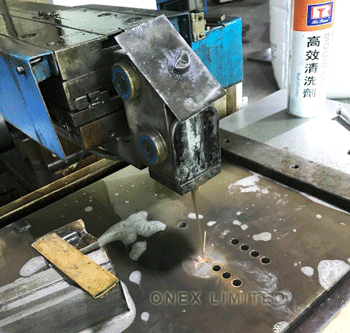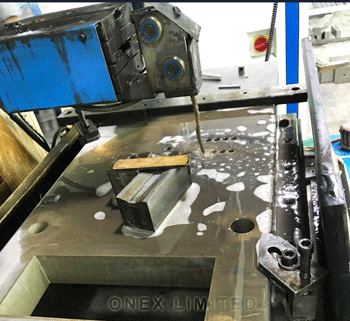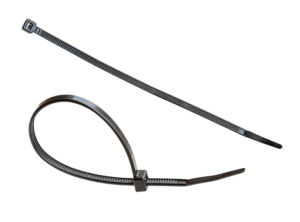
Cable Tie Mold
– The Core of Efficient Production
Work with us and gain access to over 10 years of cable tie production expertise.
In the injection molding industry, moulds are one of the most critical components, directly affecting production efficiency and product quality.
This is especially true for cable tie manufacturing, where precision and durability are essential.
However, for new cable tie manufacturers, developing and selecting the right moulds can be a complex and challenging task.
That’s where we come in.
We leverage our extensive technical knowledge and manufacturing experience to provide high-quality cable tie moulds, particularly for new manufacturers looking to establish a solid foundation in the industry.
Why Buy Cable Tie Molds from Us?
Over 10 Years of Cable Tie Production Expertise
Benefit from our extensive experience in cable tie manufacturing technology and solutions.
200+ Cable Tie Molds Purchased Annually
We maintain strong supplier relationships, ensuring reliable quality and consistent mold supply.
Optimized Mold-Machine Integration
With deep expertise in injection molding machines , we ensure seamless compatibility for optimal performance.
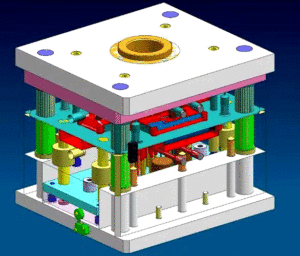
Three Types of Cable Tie Moulds for Different Needs
We offer three categories of cable tie moulds, each designed to suit different production requirements and investment levels:
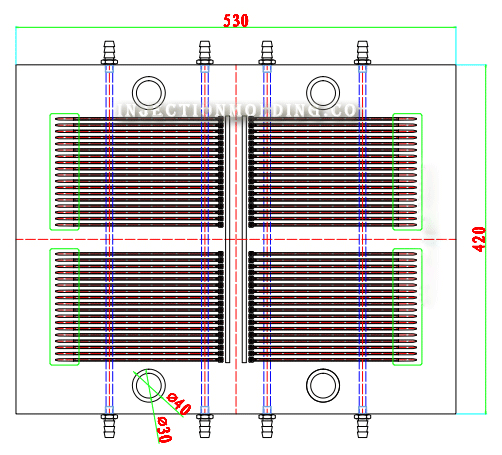
1. Standard Plate Moulds
- Advantages: Cost-effective and suitable for entry-level production.
- Drawbacks: Over time, the mould base may deform( after one year or one million clamps )
- Impact on Machines: The stress area is concentrated, which challenges the injection molding machine clamping unit.
2. Frame Moulds (Core and Frame Separation)
– Improvements Over Plate Moulds:
- Separates the mould cavity (core) from the frame, easily maintain.
- Increases the mould’s surface area, leading to more even force distribution across the machine’s clamping unit.
– Cost Consideration: Slightly higher investment than standard plate moulds, but significantly improves longevity and performance, both for machine and mold.
3. Hot Runner Moulds (Technically, Semi-Hot Runner Moulds)
– Advanced Design: Uses hot runner injection points( usually two points ) to push the molten plastic forward, improving material flow and reducing defects.
– Performance Benefits:
- Enhances molding quality and consistency.
- Increases production efficiency and reduces material waste.
- Less impact for machine’s clamping unit.
– Best for: Large-scale production lines requiring high output and precision.
Two option for hot runner system: international or Chinese
Important Post
Breve Introduction:
Discover the pros & cons of hot runner molds.
Drawbacks from 10+ years of expertise.
Optimize your nylon manufacturing today!
FAQ: Attention Points for Cable Tie Mold Design and Purchasing
Q1: Why is cavity quantity crucial in cable tie mold design?
Answer: The correct number of cavities significantly influences the stability and success of the injection molding process.
Due to the slim and non-standard dimensions of cable ties, inexperienced mold makers may design molds with an incorrect number of cavities—either too many or based solely on the machine plate size—leading to unstable or failed production.
Q2: What factors determine the ideal number of cavities for a cable tie mold?
A: Two main factors influence this decision: the injection molding machine’s capability and the raw material properties.
Balancing these ensures consistent and stable production over many years.
We refer to the balance of machine, mold, and material as “3M,” the fundamental principle of the injection molding industry.
Q3: How important are inserts and ejectors in cable tie molds?
A: Inserts and ejectors are critical components affecting mold cost and performance.
Mass production of these parts helps reduce overall costs.
Inserts, in particular, are essential for achieving precise cable tie shapes and dimensions.
Q4: Why is mold temperature important in cable tie production?
A: Correct mold temperature significantly reduces preheating time, boosting productivity and output.
Q5: What should I inspect when evaluating a new cable tie mold?
A: Inspect for accurate cable tie dimensions, absence of flash, discoloration (yellowing), and the presence of bubbles:
- Dimensions: Some manufacturers slightly shorten the length (e.g., 118mm instead of 120mm). Usually acceptable since tails are trimmed.
- Flash: Unacceptable; contact us if encountered.
- Yellowing: Typically due to overheating caused by excessive cavities or using too much recycled material.
- Bubbles: Various causes; solutions provided upon consultation.
Q6: What is the difference between cold runner and hot runner molds for cable ties?
A: Hot runner molds for cable ties are typically semi-hot runners with one or two injection points.
These improve melting efficiency and reduce temperature loss during material flow.
Q7: How should I maintain my cable tie mold?
A: Regularly apply grease to the guide pins.
Avoid using thin oil.
Q8: How should cable tie molds be fixed?
A: Proper mold fixing techniques should follow the manufacturer’s guidelines to ensure stability and longevity during production.
How to Buy Cable Tie Mold
Cable tie mold is one part of the triangle of the injection molding machine, materials and mold, which are the three main elements of the injection molding industrial. Here is the cable tie manufacturing.
The key for the successful cable tie manufacturing is these three elements work together.
Solutions to Flash Issues in Cable Tie Production
In the production of cable ties, flashes are common and troublesome issues that directly affect the appearance and performance of the products.
Flashes not only increase production costs but can also lead to customer dissatisfaction, thereby impacting brand reputation. Therefore, understanding the causes of flashes and effective solutions has become a pressing topic for every cable tie manufacturing enterprise.
On-Site Mold Testing – 70+ Video Clips
In a collaborative project with a client, we used a 358-ton injection molding machine and 10 molds to conduct a comprehensive production line setup and testing.
This experience was meticulously documented in 70 videos.