
PP Security Seals: How to Choose Between UV Laser Marking and Infrared Laser Marking
PP Security Seals: How to Choose Between UV Laser Marking and Infrared Laser Marking A practical guide to choosing the right marking process for polypropylene
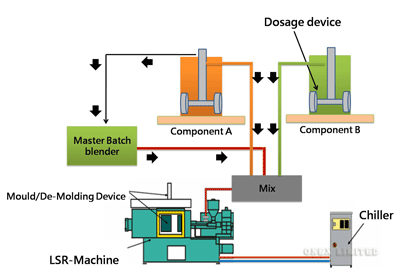
There are many differences between the processing of LSR and traditional thermoplastic rubber, which increase the processing difficulty. LSR is quite different from traditional thermoplastic material processing in terms of shrinkage, demoulding, mold material, cold runner system, temperature control, etc. That makes the processing of LSR more difficult than that of ordinary thermoplastic rubber.
The waterproof silicone ring of smart phone is mostly made of secondary molding on the original metal or plastic parts. At the same time, the volume is smaller than the commonly used silicone ring. And the matching degree with the case and accessories is higher. So it needs a more precise (minimal amount) injection molding technology.
The key to achieve the precision injection molding of LSR is as follows:
Precise mixing ratio: LSR is a two-component raw material of A and B. Before injection molding, it must be fully mixed according to the proportion of 1:1. If it is a colored liquid silicone product, the color paste ratio must also be accurately controlled.
Mixer: The static mixer is a key component in injection molding. Only after the A and B is fully and uniformly mixed by the static mixer, can the liquid silica gel injected into the mold be completely vulcanized.
Due to the low viscosity of LSR, we must consider the backflow and leakage of materials and seal the screw.
Since the mold is heated during the LSR molding process, in order to prevent the LSR from solidifying,can adopt a water-cooled nozzle to keep the temperature low enough.
Parting line: Consider the position and accuracy of the parting line in advance to help avoid air entrainment and welding, and avoid burrs.
Shrinkage: Although LSR does not shrink during injection molding, it usually shrinks by 2% to 3% after demolding and cooling. Because its extremely thermal expansion coefficient is very high.
The position of the glue injection port: we should consider the actual shrinkage rate of products.
Vacuuming: When designing the parting line, ensure that the mold is sealed. And the vacuum pump will vacuum all the cavities through the clamp under the mold switch.
Demoulding: generally adopt the demoulding technology of fractionating column tray, ejector pin and air ejector, or manual demoulding.
Mold temperature: LSR is vulcanized during heating. We should control the temperature inside the mold and make it evenly distributed. What’s more, we should control the temperature difference at +/-10℃.

PP Security Seals: How to Choose Between UV Laser Marking and Infrared Laser Marking A practical guide to choosing the right marking process for polypropylene

How Are Plastic Security Seals Printed? 6 Methods Explained A Complete Comparison of Common Marking Processes Plastic security seal printing methods play an important role
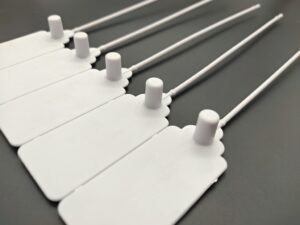
Controlled Breakaway Cable Ties: How They Differ from Security Seals Similar in Appearance, but Designed to Solve Two Different Problems Security seals and controlled breakaway
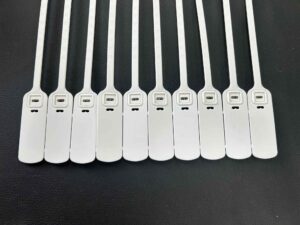
Comparison of Ultrasonic Welding and Heat Staking in Security Seal Production Lines In the production of Security Seals, injection molding is only one part of